
In the last two decades of the 19th century, several research groups demonstrated the influence of the nervous system on bacterial infection.
Viewpoint on:
Hofbauer L, von Czyhlarz ER. Ueber die Ursachen des Nerveneinflusses auf die Localisation von pathogenen Mikroorganismen [AU: On the Causes of the Influence of the Nervous System on the Localization of Pathogenic Microorganisms]. Allgemeine Pathologie und Pathologische Anatomie 1898;16/17:657-671
Introduction
In the Expert Viewpoint of March 28, 2024, on the influence of stress on susceptibility to infection, we mentioned the groundbreaking work of Rasmussen and colleagues (2). These authors demonstrated that stress markedly worsened the outcome of herpes simplex virus infection in mice. Stress activates the stress axes including the hypothalamic-pituitary-adrenal axis and the sympathetic nervous system, which can strongly influence the immune system. These experiments indicate hormonal (e.g., cortisol) and neuronal influence on viral disease.
We need to go back in time – into the 19th century – to find the first literature on this neuronal influence. Indeed, in an excellent summary of Salvioli and Spangaro of 1899 (3), the authors described several experimental methods to sever the nervous system and the respective outcome after bacterial infection from the years 1889 to 1898 (4-11). One can also say that it was “chic” to study the influence of the nervous systems on infectious diseases; nevertheless, the given reference list (4-11) is incomplete. For the author of this Blog, the work of Hofbauer and Czyhlarz – two Austrians – showed the best and clearest results how the sympathetic nervous system influenced infection with Staphylococcus aureus (1).
The authors
Dr. Ludwig Hofbauer was born on May 19, 1873, in Vienna, Austria. He rose to prominence as a respected lecturer (Dozent) of Internal Medicine at the prestigious Medical School of the University of Vienna. He specialized in respiratory physiology, autonomic nervous system interactions, and standard pathology, contributing extensively to early 20th-century German-language medical literature. Following the Nazi annexation of Austria (Anschluss), he was targeted and persecuted due to his Jewish heritage. His official license to teach (Venia legendi) was revoked, and he was formally dismissed and expelled from the University of Vienna on April 22, 1938. He successfully emigrated to escape the Nazi regime. Hofbauer lived in Wisconsin for over 15 years. Stripped by the grand lecture halls of Vienna, his time in America was spent away from the academic limelight that marked his early career. He passed away on November 3, 1955, in Wisconsin, United States.
Dr. Ernst Ritter von Czyhlarz was born on October 1, 1873, in Prague (then part of Austria-Hungary). He was the son of Karl von Czyhlarz, one of Europe’s most celebrated professors of Roman Law. After completing his medical studies, he specialized in pathological histology. In 1901, he completed his habilitation (Privatdozent) with a thesis on the neutralization of toxins at the First Department of Internal Medicine within the Vienna General Hospital (AKH). He was a highly versatile researcher. In addition to discovering what would later be known as Mounier-Kuhn syndrome in 1897, he published extensive studies on animal peroxidases, cardiovascular pathology (angina pectoris), and gastrointestinal diseases like membranous enteritis. In 1904, his rising career hit a major roadblock when he contracted tuberculosis, forcing him to pause his work for an entire year to recover. Following his recovery, he was appointed Chief Physician (Primararzt) of the 3rd Medical Department at the Kaiser-Franz-Joseph-Spital (known today as the Klinik Favoriten). He also managed physiological research departments where he mentored younger scientists. He survived the collapse of the Austro-Hungarian Empire, the interwar hardships, and World War II while living at his long-time Vienna residence. He passed away on January 3, 1950, at the age of 76 at a care facility on the Baumgartner Höhe (now Klinik Ottakring).
The results (1)
In the decisive experiments, Hofbauer and Czyhlarz blocked the sympathetic nervous influence to the lower left extremity of rabbits by severing the sympathetic chain. Directly after this procedure, they injected a defined amount of Staphylococcus aureus into the jugular vein. Thereafter, they studied several joint regions and the bone marrow of the left and the right leg using bacterial culture techniques to study bacterial colonies. They investigated 10 rabbits and they were able to show that cultured colonies of Staphylococcus aureus were more numerous on the paralytic side independent of the localization (knee joint, ankle joint, bone marrow). The results for the knee joint are given in the following figure.
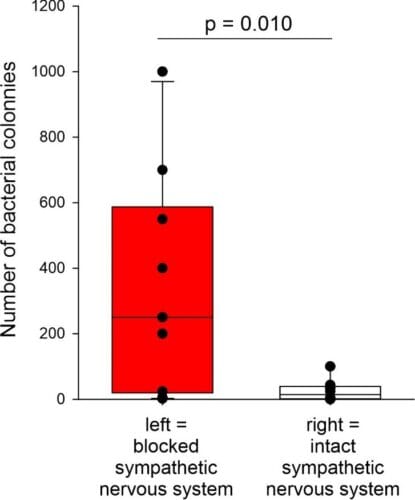
Figure 1. Number of colony-forming bacterial units in synovial fluid of the knee joint after severing the sympathetic nervous influence to the left leg. (Source: The data came from raw numbers in the publication ref. 1. SigmaPlot is used for creating the figure.)
They also demonstrated that manipulating motor nerves or sensory nerves did not lead to the same effects. In their Discussion, they wrote:
Through the entirety of our experiments, we have provided proof that the unfavorable influence of cutting the sciatic nerve on the localization of microorganisms circulating in the blood is not due to the loss of motility (motor nerves) or sensibility (sensory nerves), but solely and exclusively to the failure of sympathetic nerve fibers.
In the 1990s, the blogger and his team confirmed these old data for gram-positive Staphylococcus aureus by looking into other organs like spleen, lungs, and liver (12). However, the situation was remarkably different during sepsis with gram-negative bacteria such as Pseudomonas aeruginosa and E.coli. Here, sympathectomy decreased bacterial tissue burden (12). Other demonstrated a protective effect of removal of the sympathetic nervous system on infection with the gram-positive Listeria monocytogenes (13-14), and another group demonstrated the protective effect of the sympathetic nerve fibers in Friend retrovirus infection in mice (15). Effects of the sympathetic nervous system on infection are, thus, quite heterogeneous, and there is certainly not a uniform reaction.
References
- Hofbauer L, von Czyhlarz ER. Ueber die Ursachen des Nerveneinflusses auf die Localisation von pathogenen Mikroorganismen [AU: On the Causes of the Influence of the Nervous System on the Localization of Pathogenic Microorganisms]. Allgemeine Pathologie und Pathologische Anatomie 1898;16/17:657-671
- Rasmussen AF Jr, Marsh JT, Brill NQ. Increased susceptibility to herpes simplex in mice subjected to avoidance-learning stress or restraint. Proc Soc Exp Biol Med. 1957;96:183-189
- Salvioli J, Pangaro S. Wie ist der Einfluss des Nervensystems auf den Verlauf der Infectionen zu deuten? Archiv für pathologische Anatomie und Physiologie und für klinische Medicin 1899;155:98-123
- Charrin A, Ruffer MA. Influence du système nerveux sur l’infection [AU: Influence of the nervous system on infection]. Comptes rendus des séances de la Société de Biologie et de ses filiales 1889;41:208-210
- Roger GH. Influence des paralysies vaso-motrices sur l’évolution de l’érysipèle expérimental. Comptes rendus des séances de la Société de biologie et de ses filiales 1890:16
- Sawtschenko I. Zur Frage über die Immunität gegen Milzbrand. Centralblatt für Bakteriologie und Parasitenkunde 1891;9:14(pp. 473–480), 15 (pp. 493–501) and 16 (pp. 528–536).
- Dache J, Malvoz E. Nouveaux faits concernant le role du système nerveux dans l’infection microbienne. Annales de l’Institut Pasteur 1892;6:538-543
- Ochotine I. Influence de la paralysie vaso-motrice sur l’évolution de l’inflammation produite par le streptococcus de l’érysipèle. Archives de médecine expérimentale et d’anatomie pathologique 1892;4:245–261.
- Pellizzi GB. Influenza della paralisi vasomotoria e del taglio dei nervi sensitivi sullo sviluppo dell’infiammazione e dell’ascesso prodotto dallo streptococco dell’oto-ematoma dei pazzi. Rivista sperimentale di freniatria 1893;19:343-404
- Giuffrè L, Pollaci G. Contributo allo studio dell’immunità. Influenza del sistema nervoso sulla infezione. Studio critico e sperimentale. Archivio italiano di clinica medica 1895;34:47-97
- Trambusti A, Comba C. Influenza delle alterazioni del sistema nervoso sulla localizzazione e sul decorso dei processi infettivi. Lo Sperimentale. Giornale italiano di scienze mediche 1895;49:211-326
- Straub RH, Pongratz G, Weidler C, Linde HJ, Kirschning CJ, Glück T, Schölmerich J, Falk W. Ablation of the sympathetic nervous system decreases gram-negative and increases gram-positive bacterial dissemination: key roles for tumor necrosis factor/phagocytes and interleukin-4/lymphocytes. J Infect Dis. 2005;192:560-572
- Rice PA, Boehm GW, Moynihan JA, Bellinger DL, Stevens SY. Chemical sympathectomy increases the innate immune response and decreases the specific immune response in the spleen to infection with Listeria monocytogenes. J Neuroimmunol. 2001;114:19-27
- Miura T, Kudo T, Matsuki A, Sekikawa K, Tagawa Y, Iwakura Y, Nakane A. Effect of 6-hydroxydopamine on host resistance against Listeria monocytogenes infection. Infect Immun. 2001;69:7234-7241
- Blömker D. Die Rolle des sympathischen Nervensystems im murinen Friend Retrovirus-Infektionsmodell. Dissertation University Duisburg-Essen, 2015.
(Featured image declaration: modified from Foto von Janice Haney Carr, Matthew J. Arduino, DRPH, USCDCP at Pixnio and macrovector from Flickr)