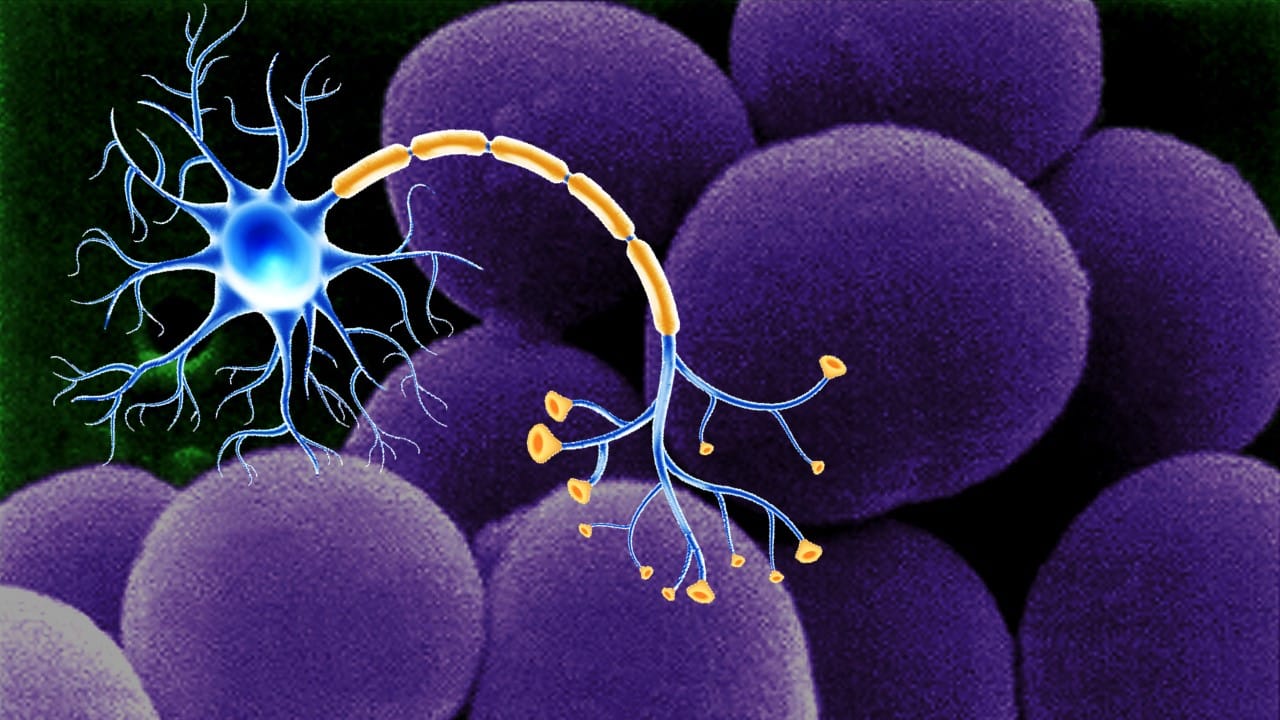
The brain uses efferent sympathetic nerve fibers with its neurotransmitter noradrenaline to make contact with immune cells in peripheral lymphoid organs like the spleen. Who discovered it?
Viewpoint On:
von Euler US. A specific sympathomimetic ergone in adrenergic nerve fibres (sympathin) and its relations to adrenaline and nor-adrenaline. Acta Physiol Scand 1946;12:73-97
von Euler US. A substance with sympathin E properties in spleen extracts. Nature 1946;157:369
The idea
Already in the mid-19th century, the Swiss professor of anatomy, Albert von Kölliker, described the innervation of the spleen as nerve fibers accompanying blood vessels. He mentioned that nerve fibers of ox and sheep are huge, similarly in size like the splenic artery (1). Kölliker also recognized that these nerve fibers were unmyelinated – called Remak fibers according to Robert Remak (1815-1865) who found them elsewhere. However, the subtype of the nervous system – whether sympathetic or parasympathetic – was not known.
Different involuntary autonomic nerve fiber types were already known in the early 20th century when John Newport Langely, in 1921, distinguished the sympathetic, from the parasympathetic, and from the enteric nervous system (2). However, the individual neurotransmitters of the different nerve fiber types were not found. Different groups discovered adrenaline in the adrenal glands at the transition from the 19th to the 20th century (3-5), and adrenaline was discussed to be the first hormone isolated (6).
In studying the sympathomimetic properties of stimulation of sympathetic nerve fibers Cannon and Bacq, initially, thought that adrenaline is released from the sympathetic nerve fibers (7). However, further studies of Cannon and Rosenbluth showed that stimulation of sympathetic nerves elicited remote actions, which were different from adrenaline effects (8). This prompted several groups to study the real neurotransmitters of sympathetic nerve fibers.
The discovery
The Swede Ulf S. von Euler (1905-1983, Nobel Prize in 1970) started his work in the Karolinska Institute, Stockholm, Sweden. In his thesis, he worked on vasoconstriction, and at the beginning of the 1930s, he thrived in the laboratory of Sir Henry Dale, London. Returning to Stockholm, he was appointed full professor in 1939 at the Karolinska Institute. He worked on prostaglandins and angiotensin before he began to study neurotransmitters of the sympathetic nervous system. From the start, he recognized that the spleen is an ideal organ because it contained high amounts of a pressor substance (vasoconstriction). In his seminal papers of the year 1946 (9, 10), he described noradrenaline in splenic extracts (9) and in sympathetic nerves of the spleen (10). Noradrenaline was identified by a multitude of biological tests that were standard at the time of von Euler. He also recognized that cutting the sympathetic nerve fibers to the spleen leads to a clear reduction of the sympathomimetic pressor substance in the spleen (10). In many further studies, von Euler refined his early work (e.g. 11, 12).

Illustration showing the contact between a spleen cell and the sympathetic nerve ending. Schematics were created by the blogger.
Discussion
Between the 1940s and mid-1960s, scientists thought that sympathetic regulation in the spleen serves solely vasoregulation and perhaps storage of red blood cells – and nothing else. The term sympathetic neuroimmunomodulation was not born. This changed with the work of several groups in the late 1960s (13). This was corroborated by new staining techniques of sympathetic nerve fibers (14-17). After the discovery of the key enzyme of catecholamine production – the tyrosine hydroxylase (18) – specific staining of sympathetic nerve fibers became possible. Both techniques – chemical and immunological – together with the understanding of a crosstalk between immune cells and sympathetic nerve fibers (13) led to clear evidence of anatomical contact sites between nerve fibers and immune cells in lymphoid organs studied by David Felten and his group (summarized in 19, and some more publications).
Sympathetic neuroimmune interactions stood the test of time, and Neuroimmunomodulation published some relevant experiments (20 – 24, and many more).
References
- von Kölliker A. Handbuch der Gewebelehre des Menschen für Aerzte und Studirende. Verlag W.Engelmann, Leipzig, 1852, p. 445
- Langely JN. The autonomic nervous system. Cambridge: W. Heffer and Sons, Ltd; 1921
- Oliver G, Schäfer EA. The physiological effects of extracts of the suprarenal capsules. J Physiol. 1895;18(3):230–276.
- Abel J. On epinephrine, the active constituent of the suprarenal capsule and its compounds. Proc Am Physiol Soc. 1898(3–4):3–5.
- Takamine J. Adrenalin, the active principle of the suprarenal glands, and its mode of preparation. Am J Pharm. 1901;73:523–31.
- Rao Y. The first hormone: adrenaline. Trends Endocrinol Metab. 2019;30:331–334.
- Cannon WB, Bacq ZM Studies on the conditions of activity in endocrine organs A Hormone Produced by Sympathetic Action on Smooth Muscle. Am J Physiol 1931;96: 392-412
- Cannon WB, Rosenbluth A. A comparison of the effects of sympathin and adrenine on the iris. Am J Physiol 1935;113:251-258
- von Euler US. A substance with sympathin E properties in spleen extracts. 1946;157:369
- von Euler US. A specific sympathomimetic ergone in adrenergic nerve fibres (sympathin) and its relations to adrenaline and nor-adrenaline. Acta Physiol Scand 1946;12:73-97
- von Euler US, Stjärne L. Studies on the release of the adrenergic neurotransmitter in the perfused ox spleen. II. Effects of various membrane active substances. Acta Physiol Scand Suppl. 1955;33(118):70-74
- von Euler US, Hillarp NA. Evidence for the presence of noradrenaline in submicroscopic structures of adrenergic axons. Nature 1956;177:44-45
- demonstrated in the Viewpoint of July 24, 2024: https://researchviewpoints.karger.com/on-research/pillar-articles-adrenergic-modulation-of-leukocytes-anni-mirabiles-1968-to-1970/
- Falck B, Torp A. A fluorescence method for histochemical demonstration of noradrenalin in the adrenal medulla. Med Exp Int J Exp Med. 1961;5(6):429–432.
- Dahlstroem AB, Zetterstroem BE. Noradrenaline stores in nerve terminals of the spleen: changes during hemorrhagic shock. Science. 1965;147(3665):1583–1585.
- Gillespie JS, Kirpekar SM. The histological localization of noradrenaline in the cat spleen. J Physiol 1966;187:69-79
- Hamberger B, Malmfors T, Stjärne L. Noradrenaline uptake and fluorescence histochemistry in bovine splenic nerves. Acta Physiol Scand. 1971;82(1):107–114.
- Nagatsu T, Levitt M, Udenfriend S. Tyrosine hydroxylase. J Biol Chem. 1964;239(9):2910–2917.
- Felten DL, Felten SY, Bellinger DL, Carlson SL, Ackerman KD, Madden KS, et al. Noradrenergic sympathetic neural interactions with the immune system: structure and function. Immunol Rev. 1987;100:225–260
- Genaro AM, Cremaschi GA, Gorelik G, Sterin-Borda L, Borda ES. Downregulation of beta adrenergic receptor expression on B cells by activation of early signals in alloantigen-induced immune response. Neuroimmunomodulation. 2000;8:114-21
- Page GG, Ben-Eliyahu S. Natural killer cell activity and resistance to tumor metastasis in prepubescent rats: deficient baselines, but invulnerability to stress and beta-adrenergic stimulation. Neuroimmunomodulation. 2000;7:160-168
- Oberbeck R, Schmitz D, Wilsenack K, Schüler M, Pehle B, Schedlowski M, Exton MS. Adrenergic modulation of survival and cellular immune functions during polymicrobial sepsis. Neuroimmunomodulation. 2004;11:214-223
- Kitamura H, Shiva D, Woods JA, Yano H. Beta-adrenergic receptor blockade attenuates the exercise-induced suppression of TNF-alpha in response to lipopolysaccharide in rats. Neuroimmunomodulation. 2007;14:91-96
- Straub RH, Dufner B, Rauch L. Proinflammatory α-Adrenergic Neuronal Regulation of Splenic IFN-γ, IL-6, and TGF-β of Mice from Day 15 onwards in Arthritis. Neuroimmunomodulation. 2020;27:58-68
(Featured image declaration: Obtained from”Overview of splenic innervation of a C57BL/6 mouse” from Hu, D., Al-Shalan, H.A.M., Shi, Z. et al. Distribution of nerve fibers and nerve-immune cell association in mouse spleen revealed by immunofluorescent staining. Sci Rep 10, 9850 (2020). https://doi.org/10.1038/s41598-020-66619-0, CC BY 4.0 license )