The vagus nerve changes immune function, which has been studied for a long time. The vagus transmitter acetylcholine can have immunosuppressive effects – a phenomenon discovered in the 1950s using bacterial phagocytosis.
Viewpoint On:
Ludány G, Vajda J, Erdös E. Die Uberträgersubstanzen der Erregung des vegetativen Nervensystems und die Phagozytose der Leukozyten [The effect on leukocyte phagocytosis of substances intermediate in the transmission of autonomic stimulation]. Arch Int Pharmacodyn Ther. 1951;87(1-2):49-63. PMID: 14857838.
The authors
Prof. György Ludány was the major stimulator of this research from the 1930s to the 1970s and, thus, his biographical sketch is demonstrated here: György Ludány was born in 1907 in Debrecen in east Hungary. He studied Medicine in Debrecen and received his degree in 1932. Already during his student years, from 1928 to 1932, he was engaged in physiological research. Soon after his studies, in 1938 he received his qualification for a teaching career in higher education (Habilitation). After several career steps in Hungary and Romania (Tihany and Cluj-Napoca), he came back to Budapest Medical University, where he – as a professor in the Department of Surgery – founded the Experimental Research Laboratory of this institute. He published more than 200 articles in Hungarian, Romanian, German and English. He was a founding member of the Hungarian Physiological Society, the Hungarian Society for Microbiology, the Hungarian Society of Pharmacology. Since 1967, he was a member of the Hungarian Society of Surgeons. He died in 1981 in Budapest.
The starting point
In the 1930s, Ludány was interested in opsonization and phagocytosis (3). Opsonization is an innate immune process where pathogens or foreign particles are coated with proteins called opsonins – primarily antibodies (IgG) and complement proteins (C3b) – to make them susceptible to phagocytes. Ludány studied phagocytosis using leukocytes and Staphylococci and Typhus bacilli. Already in the early work, he was able to demonstrate a stimulating effect of electrical stimulation of the sympathetic nervous system on phagocytosis (3). Thus, it was no surprise that he wished to study the effects of the opposing neuronal system – the parasympathetic nervous system with its major neurotransmitter acetylcholine.
The discovery
In the critical work of Ludány and colleagues (4), the authors concentrated mainly on neurotransmitters of the sympathetic nervous system. They demonstrated a clear stimulation of adrenaline or noradrenaline on phagocytosis of staphylococci and typhus bacilli. In one smaller part of the publication, they also worked with acetylcholine. Although acetylcholine did not directly manipulate phagocytosis in this work (4), parenteral administration of acetylcholine to dogs inhibited phagocytosis. The major effect was observable after 20 minutes. In an earlier work of the year 1950, they demonstrated a clear inhibitory effect on phagocytosis using pilocarpine, a direct acting parasympathomimetic at the M3 muscarinic receptor (5).
The work was later supported by other groups (6-7) while also opposing effects were demonstrated using other experimental systems (8-12).
Discussion
Today, we know that acetylcholine binds to many different muscarinic and nicotinic receptors with sometimes opposing activities. Thus, the different effects of acetylcholine observed during the last half century probably depends on the different parasympathomimetics used, different receptors activated and expressed in cells, different cell types and culture conditions. In addition, we know that immune cells can produce acetylcholine on their own (see expert Viewpoint of October 28, 2024, and ref. 13), which can interfere with local acetylcholine effects. Since the year 2000, effects of vagus nerve stimulation are studied, which often demonstrate anti-inflammatory effects (14).
Neuroimmunomodulation also published papers on the link between the cholinergic system and immune function (15-17).
References
- https://www.nevpont.hu/palyakep/ludany-gyorgy-fd109
- https://hu.wikipedia.org/wiki/Ludány_György
- Goreczky L, Ludány G. Die phagocytosefördernde Eigenschaft des Depotserums der Milz. Z. Ges. Exp. Med. 1937;101;187-194
- Ludány G, Vajda J, Erdös E. Die Uberträgersubstanzen der Erregung des vegetativen Nervensystems und die Phagozytose der Leukozyten [The effect on leukocyte phagocytosis of substances intermediate in the transmission of autonomic stimulation]. Arch Int Pharmacodyn Ther 1951;87(1-2):49-63
- Szöke A, Lövei E, Vajda G, Ludány G. Die wirkung von sympathico- und parasympathicomimetischen Stoffen auf die phagozytosefördernde Fähigkeit des menschlichen Blutserums [Effect of sympathico- and parasympathicomimetics on opsonification in human serum]. Wien Klein. Wochenschr 1950;62:793-795.
- Shchastnyĭ FF, Barancheev NI. Vliianie adrenalina i atsetilkholina na fagotsitarnuiu funktsiiu leĭkotsitov novorozhdennykh deteĭ [The influence of adrenaline and acetylcholine on the phagocytic function of leukocytes in newborns]. Pediatriia. 1965;44:47-49.
- Du X, Tang Y, Han Y, Ri S, Kim T, Ju K, Shi W, Sun S, Zhou W, Liu G. Acetylcholine suppresses phagocytosis via binding to muscarinic- and nicotinic-acetylcholine receptors and subsequently interfering Ca2+- and NFκB-signaling pathways in blood clam. Fish Shellfish Immunol. 2020;102:152-160
- Ignarro LJ, Lint TF, George WJ. Hormonal control of lysosomal enzyme release from human neutrophils. Effects of autonomic agents on enzyme release, phagocytosis, and cylic nucleotide levels. J Exp Med. 1974;139:1395-1414
- Ignarro LJ, Cech SY. Bidirectional regulation of lysosomal enzyme secretion and phagocytosis in human neutrophils by guanosine 3′,5′-monophosphate and adenosine 3′,5′-monophosphate. Proc Soc Exp Biol Med. 1976;151:448-452
- Gómez RM, Berría MI, Sterin-Borda L. Cholinergic modulation of baker’s yeast cell phagocytosis by rat astrocytes. Neurosci Lett. 2004;365:19-22
- van der Zanden EP, Snoek SA, Heinsbroek SE, Stanisor OI, Verseijden C, Boeckxstaens GE, Peppelenbosch MP, Greaves DR, Gordon S, De Jonge WJ. Vagus nerve activity augments intestinal macrophage phagocytosis via nicotinic acetylcholine receptor alpha4beta2. 2009;137:1029-1039
- Moussa AT, Rabung A, Reichrath S, Wagenpfeil S, Dinh T, Krasteva-Christ G, Meier C, Tschernig T. Modulation of macrophage phagocytosis in vitro-A role for cholinergic stimulation? Ann Anat. 2017;214:31-35
- Kawashima K, Oohata H, Fujimoto K, Suzuki T. Extraneuronal localization of acetylcholine and its release upon nicotinic stimulation in rabbits. Neurosci Lett. 1989;104:336-339
- Borovikova LV, Ivanova S, Zhang M, Yang H, Botchkina GI, Watkins LR, Wang H, Abumrad N, Eaton JW, Tracey KJ. Vagus nerve stimulation attenuates the systemic inflammatory response to endotoxin. Nature. 2000;405:458-462
- Rinner I, Globerson A, Kawashima K, Korsatko W, Schauenstein K. A possible role for acetylcholine in the dialogue between thymocytes and thymic stroma. Neuroimmunomodulation. 1999;6:51-55.
- van der Zanden EP, Hilbers FW, Verseijden C, van den Wijngaard RM, Skynner M, Lee K, Ulloa L, Boeckxstaens GE, de Jonge WJ. Nicotinic acetylcholine receptor expression and susceptibility to cholinergic immunomodulation in human monocytes of smoking individuals. Neuroimmunomodulation. 2012;19:255-265
- Aripaka SS, Mikkelsen JD. Anti-Inflammatory Effect of Alpha7 Nicotinic Acetylcholine Receptor Modulators on BV2 Cells. Neuroimmunomodulation. 2020;27:194-202
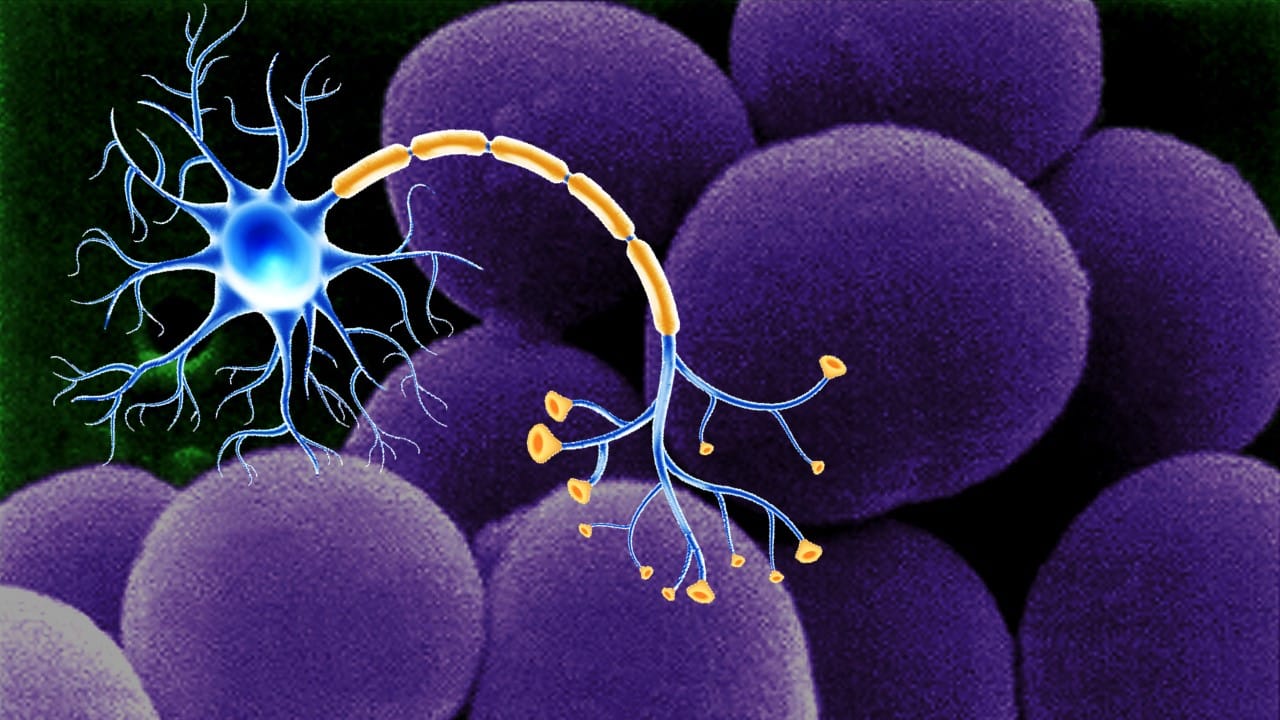
(Featured image declaration: modified from Pharmillustrator – Own work, CC0, https://commons.wikimedia.org/w/index.php?curid=171162799 and Blausen.com staff (2014). “Medical gallery of Blausen Medical 2014“. WikiJournal of Medicine 1 (2). DOI:10.15347/wjm/2014.010. ISSN 2002-4436.)